Quality Zooming

In the time since the COVID-19 virus hit us, I have been working on a new project with my GEMH lab colleagues. A project that we had to start from the very ground up. This project, which I’m excited to tell you more about in a later blog post, offered me the opportunity to engage in a kind of research I’d had no experience before whatsoever.

We’re building an app to help youth reflect on their digital tech use, and in order for us to know better what to build for our target audience and how, I set out to conduct focus groups. Focus groups are like tiny studies, in which you try to answer a number of questions with a small group of people from your target sample. I had never done this sort of group study before, and although I have interviewed youth one on one (which was a great experience), I was worried about how this would pan out, and especially since we’d have to do these focus groups online.

So far, in a couple of months, our wonderful GEMH intern Denise and I have conducted 8 focus groups, with 4-7 people in each group. These are the things I’ve learned so far.

  • Being forced to do it online has forced us to broaden our reach, in ways that we otherwise might have neglected. We have recruited young people from all over the world, and I’m incredibly happy that youth from all over have participated; from India to Malta, from Spain to the UK, from Albania to Poland. With these diverse youth we’ve had awesome conversations.
  • Yes, conversations! I continue to be pleasantly surprised at how willing and interested these young people are to talk about their lives and their digital tech use. There I was, worried about whether or not the online group dynamic would allow people to open up. Turns out, in each focus group we’ve had wonderful insights into young people’s relationship with their smartphone, not just for Denise and I, but also for the youth themselves!
  • Opening up for people is so much easier to do when you yourself, as a researcher, open up as well. This is why I increasingly feel like questionnaires are a one-way street we don’t want to go down, if we want to find out more about youth’s tech use.. Sharing my own experience, although often different from their own, has helped our participants feel free and comfortable to share their own stories. I feel that this is especially important since I’m sure that online focus groups feel different from real-life focus groups. It’s hard to get to know each other in a short amount of time as it is, and not being in the same physical space makes that even harder. So, my ultimate tip is to really engage, and not only expect your participants to share with you, but to also share with them yourself!

Looking forward to continuing this qualitative journey!

Emoji: Nice or noisy?

Every once in a while I get a text, and it has no emoji in it. And even though the text is fine, and the contents are pretty neutral, the fact that there are no emoji puts my mind in an instantaneous state of doubt — is this person mad at me?

Perhaps you recognise this feeling I just described (or maybe it’s just me — if it is, let me know in the comments). Emoji are nowadays used by so many, and so often, that when they remain absent from digital communication, the emoji-less message may read as more negative than it might have read before emoji became such a messaging staple.

We’ve become pretty dependent on these tiny little depictions of all sorts of everyday emotions and things. Their presence or absence is perhaps interpreted in different ways depending, perhaps, on state of mind or personality (just like my interpretation may be fuelled by how sensitive I am to social rejection). But what about differential interpretation of the emoji themselves? Emoji are meant to make communication easier, more straightforward, in the absence of seeing someone’s face. But could it be that in some cases they actually introduce extra communicational noise?

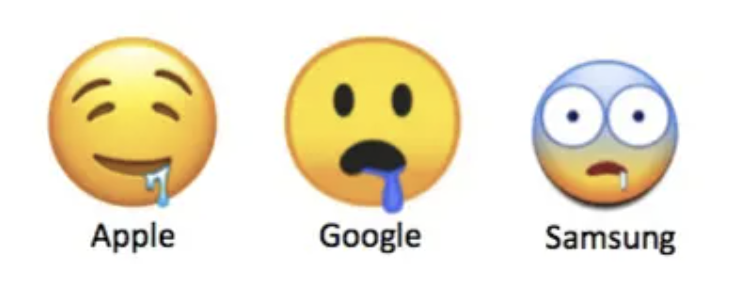
First, for anyone having had experience with different phone brands and platforms, it’s pretty astounding how different the ‘same’ emoji can look. Take for instance this range of ‘drooling’ or ‘person frowning’ emoji, depicted below. The emotion they exude is quite inconsistent; whereas the first drooling face seems to say ‘mmm, delicious’, the second has more of a ‘vegetative state’-feel to it, and the third has seen stuff, if you know what I mean. The frowning girls are also pretty dissimilar, with the first one looking like you broke up with her, the second seeming more disappointed/disinterested in you, and the third one looking plain angry.

Also, anyone using platforms where shorthand can be used to call upon emoji (such as Slack, or the discontinued MSN Messenger), may have had the experience of conveying the emotion depicted by an emoji, simply by using the shorthand. For instance, I still regularly use “:aap4:” (which would upon completion have transformed into a cute animated monkey, in MSN Messenger) on platforms which do not support or recognise that animation/shorthand. Of course, this implies that you and your communication partners share a common (visual!) ‘dictionary’ of emoji. This just goes to show that people’s internal representations of emoji play a large role in their effectiveness as a means of communication.

There has been some interesting research on emoji done so far that seems to confirm the sense that emoji can be pretty noisy: a 2020 study found “limited shared agreement for the majority of emoji–emotion pairings, and significant variation as to which emotion category a “comparable” emoji belonged depending upon the viewed platform”. In other words; you’re likely to perceive the emoji’s emotional meaning differently depending on the variant you come across.

So, I guess my personal take-away from all of this is… it doesn’t hurt to double-check (or give people the benefit of the doubt) if you’re unsure about the message someone is trying to get across.

BONUS TRIVIA: Do you know what the difference is between emoticons and emoji? Well, apparently emoticons are ‘faces’ constructed with typographic symbols, like “;)”. Emoji, on the other hand, are the actual picture-faces (or vegetables, or whatever), like the ones in the pictures above. The more you know.

Person-centric AI

During my time at the GEMH Lab I’ve become more and more interested in the relationship that people have with technology. Not only in terms of ‘how do we use it’ and ‘what can we do with it’, but also how technology has been inspired by us.

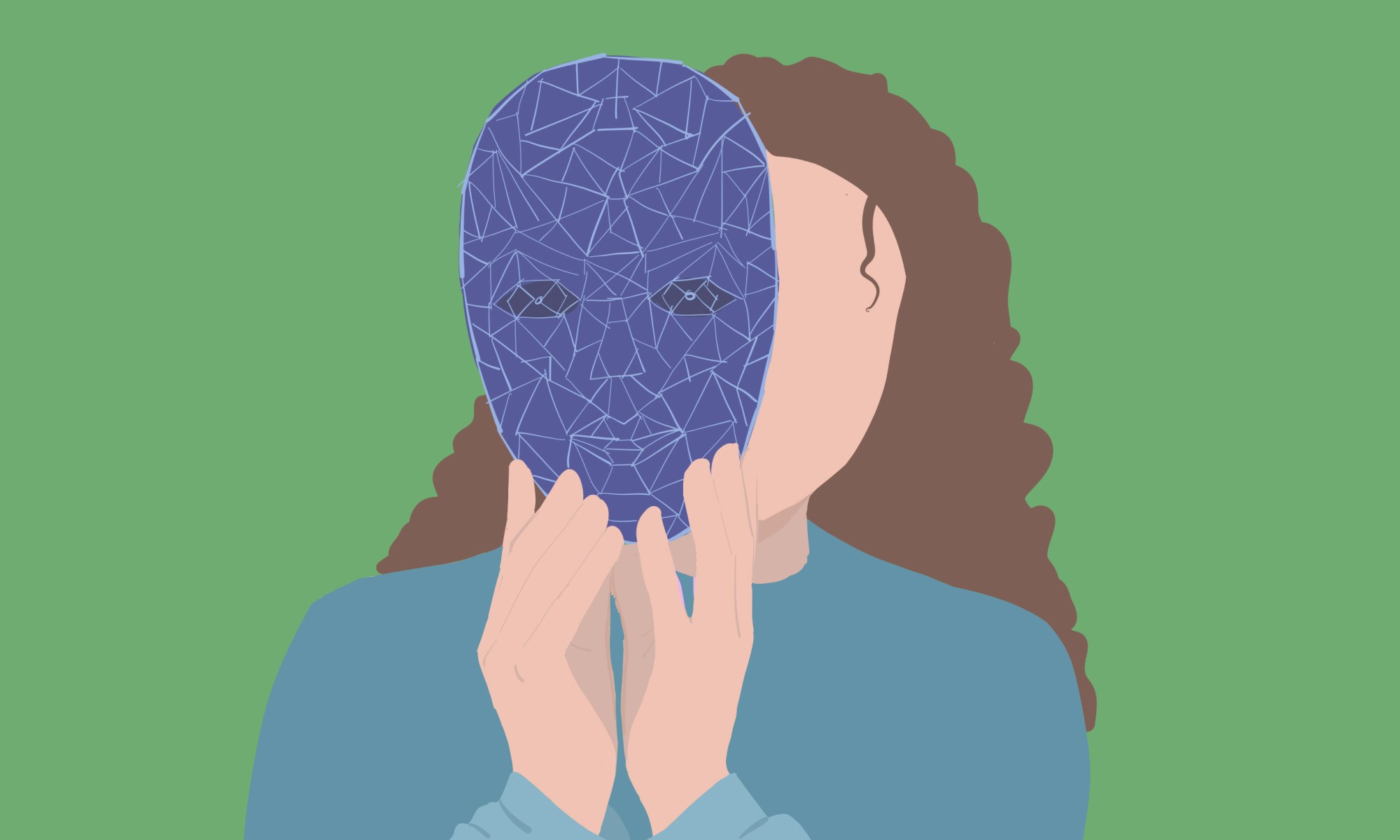
In particular artificial intelligence is meant to mimic us in some ways (and do better than us, in others). However, recently I’ve come to believe that we’re not inspiring artificial intelligence and digital social technology to a large enough extent, and I’ll explain what I mean in a second.

When you Google ‘person-centric’ (or ‘human-centric’/’people-centric’) AI, you get pages that refer to making AI understandable for humans. Although this is an important task (especially in the light of worries that we might be losing our grip on artificial intelligence and what it does), I was surprised to read that this is apparently what the Internet says that ‘person-centric AI’ is.

What about the psychology that goes into these tools, though? How do we strive to make sure that what we build is not just convenient and efficient, but also in line with our understanding of human psychology? Is the field of AI sufficiently sensitive to theories about human psychology? I’m getting the sense that it isn’t (but feel free to prove me wrong, see the end of my post ;).

Why does it matter? Because in order for human beings to benefit the most from technology, it needs to be sensitive to their needs. Things like preservation of the sense of agency, for instance, seem to be rarely taken into account, following an ‘aren’t you happy someone/something is doing it for you?’-approach. However, a loss of sense of agency can not only lead to reluctance to use a certain technological tool, it can also lead to decreased life satisfaction. In a world where we are increasingly surrounded by (AI) technologies and tools, such considerations are as vital as ever.

I’m thinking… that I’d really like to work towards building AI tools that make sense from a human psychological perspective. We need to consider the human mind behind every AI tool, and this is something that – at least, so it seems – is still underrepresented in the field of artificial intelligence. However, if you read this and are working on such an approach to AI, hit me up — I’d love to hear about your work!

Why being social is so important to us

We are immensely social beings: we enjoy having friends and sharing knowledge or experiences with them, and most people try to connect with other people first chance they get. It’s not really surprising that social media have increased in popularity as much as they have, only further illustrating our desire to see and be seen, to talk to and be talked to. Why are we so drawn to social activities, though? Is there more to this desire to be part of a collective? The answer is ‘yes, there is’, and I’ll briefly explain why.

In 2003, a study conducted by researchers in the lab of neuroscientist Matthew Lieberman set out to investigate the brain’s response to social rejection1. They found, surprisingly, that the brains of their participants responded very similarly to the way the brains respond when a person is in physical pain. The researchers concluded that the human brain processes social discomfort and hurt the same way it does physical pain, even though there is no material cause. Surprising? Absolutely, especially given the fact that another study has found that painkillers affect this ‘social pain’ the same way they do ‘real’, physical pain2. But what is it about social pain that is so crucial for it to be equated to actual physical pain by our brains?

Let’s wind back, all the way to when our lives began: birth. Suffice to say that not all animals are born equally self-sufficient. Baby foals are up and running within hours of their arrival to this world, while human babies are, well… helpless. The first two months of life find human babies unable to lift their own heads without help from others, let alone stand and walk around. The only reason any of us has survived infancy is simply because we all have had a caregiver who felt such a strong connection to us that they were willing to take care of us and feed us over many years. It also helps that these caregivers feel pain when being separated from their child, same as a baby cries and experiences pain when being separated from their caregiver. 

Aeons ago our ancestors discovered that tackling problems threatening their survival was best done collectively. Sharing knowledge, food, tools and other resources helped them hunt animals, beat famine and secure the survival not only of their lives, but their genes as well. And I don’t mean Levi’s. Simply put, humans depend on other humans for survival, whether it be within their own lifetime or as a species.

Further illustrating the importance of a social network is the fact that humans, over the many thousands of years of living and surviving in groups, have developed seemingly dedicated brain regions, focused on ‘social thinking’. These important skills include empathy and being able to imagine how other people are feeling in a given situation, but also being able to predict others’ behaviours based on how we would behave ourselves. All of these dedicated skills help us work, play, and share with other people, and are so much ingrained in our functioning that a specific neural network has developed to enable us be better social beings.

Another psycho-biological theory called the ‘social baseline theory’3 states that the human brain is made to function in social contexts and that, when social support is lacking, the brain is less able to handle everyday stressors. Instead, at a ‘social baseline’ (the situation in which people perceive they can expect help from others if they find themselves in a pickle), the brain performs best, and draws strength and resilience from this invisible (and maybe even imaginary!) safety net. You have to admit, feeling like you have someone to turn to makes obstacles easier to overcome.

To conclude, I hope I have been able to illustrate shortly how important being kind to one another is ; remember that when rejecting someone or excluding them, you most likely cause them to experience the same kind of pain if you were to harm them physically. We all need each other, and being there for one another will make the lives of everyone involved a lot easier.

Further reading

  1. Eisenberger, N.I., Lieberman, M.D., Williams, K.D. (2003). Does rejection hurt: An fMRI study of social exclusion. Science. 302:290–2.
  2. DeWall, C.N., MacDonald, G., Webster, G.D., Masten, C.L., Baumeister, R.F., Powell, C., Combs, D., Schurtz, D.R., Stillman, T.F., Tice, D.M., Eisenberger, N.I. (2010). Acetaminophen reduces social pain: Behavioral and neural evidence. Psychological Science. 21:931–7.
  3. Beckes, L. and Coan, J.A. (2011). Social baseline theory: The role of social proximity in emotion and economy of action. Social and Personality Psychology Compass. 5: 976-988.