Studio Gryphire

Technology, like art, is a soaring exercise
of the human imagination.

Daniel Bell โ€” The WINDING PASSAGE

In addition to the out-there projects I love to engage in on the side, I deeply enjoy helping other teams with research and/or design challenges, especially around technology and wellbeing. Through Studio Gryphire, which consists of a Design and a Research divisionโ€”although the two may well often combine in a delicious swirl of goodnessโ€”I provide freelance services in both of these areas.

At the core of Studio Gryphire lies ensuring that human flourishing and wellbeing are supported. That is why in both my design รกnd my research work I focus on projects that relate to human wellbeing and aim toโ€”either directly or indirectlyโ€”augment and support the human experience. That is the heart of Studio Gryphire.

Interested in what I can do for you?


Design for Good

In my design work I support teams, companies and individuals with graphic and digital product design. Through my experience creating and designing both graphic material as well as user experiences, my aim is to ensure the intended message or experience reaches its destination. Looking for a logo, illustrations, a refreshed brand identity? Or are you developing an app or game for which you want to ensure human-centric, evidence-based design? I’m your gal.


Research for Good

Much like with my design work, the research support I provide for project teams, institutes and organizations varies vastly depending on needs and goals. With my expertise in a wide range of research methods and analytics, I help projects that aim to support human flourishing build a strong scientific and UX evidence-base for their product. My work ranges from literature research and study design to UX research execution, analysis, and beyond.
STUDIO GRYPHIRE
KvK / Chamber of Commerce No.: 90237234
Arnhem | Netherlands
Latest GPT Finetuning Workshops in Copenhagen

Last week, Mirabelle Jones and I organised the latest iteration of ourโ€”somewhat experimental and, some might say, riskyโ€”workshop study series, in which we invite Python novices and aficionados to finetune (i.e., create) their own version of GPT-3, based on their own social media posts and messages. We did so at the beautiful AI Pioneer Center of the University of Copenhagen.

Some of you may remember GPT-3 from the summer of 2021โ€”now considered ages ago in AI-termsโ€”as one of OpenAI’s so-called large language models (LLM). In fact, at the time, it was one of the most advanced models out there (now, it has already been surpassed by a number of newer versions, most notably ChatGPT and GPT-4). While GPT-3 has existed since 2020, it was in 2021 that OpenAI had made finetuning GPT-3 available to anyone with an OpenAI account.

Finetuning, as the word implies, comes down to the molding and adapting of an existing LLM to more accurately reflect certain characteristics of a finetuning dataset. For example, generic LLMs face criticism becauseโ€”having been built on normative, homogeneous datasetsโ€”they tend to misrepresent or be insensitive to minorities (whose data usually are underrepresented in the training datasets). Why, you might ask, are we not using ChatGPT? Unfortunately, the newer versions of GPT are not open to finetuning. Hopefully this might still become possible in the near future.

Our aim for the workshop study was to teach others how to create a personalized ‘chatbot’ based on their own social media texts. Once participants have their personal LLM, my specific angle of interest was to see if there are any insights they might glean from chatting with this potential window into their online personas.

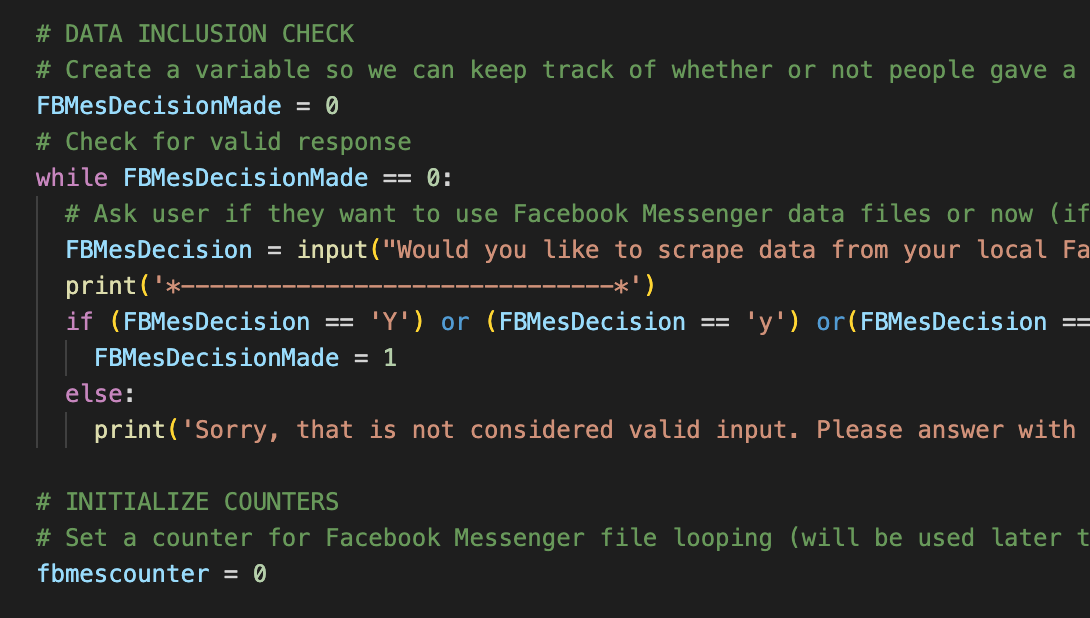
Having run two earlier versions, we decided for this iteration to include an in-person aspect, and this was by far the best approach for the level of intensity and time this workshop requires. We had also made significant improvements to the process since the previous iteration (e.g., going from participants manually assembling their finetuning dataset to using my improvised scraper script).

However, as is always the case with hands-on activities: be prepared to face the unexpected. Multiple โœจexciting new errorsโœจ popped up that I hadn’t encountered before when using the scraper scriptโ€”some of which we were able to troubleshoot on the spot, while others could not be solved within the timeframe we had. Fortunately, we had some wonderfully patient and engaged participants in our groups, and thanks to them, we learned a lot!

Based on the last two workshops in Copenhagen, we are planning on improving our process, and I will definitely be making changes to the script to ensure an even better and smoother result the next time. Mirabelle and I both look forward to inviting even more curious minds to our next iteration of GPT finetuning workshops, which will take place in the Netherlands.

The Relief of Completion

Recently I gave an interview with VICE Netherlands about completionism tendencies when playing video games. If you’ve ever played video games, you’ll likely recognise this feeling: wanting to collect all the collectibles, complete all the open quests, and basically just “100%” the game.

While preparing for the interview, I delved into the literature for some background research about what may underlie the completionist tendencies that many gamers have. As a self-care side note; don’t worry, you’re not any less of a gamer if you’re fine with putting the game down whenever you’re done with it (whether it be after 2 hours, or 200). (:

Back to completionism. I know from personal experience that it can be extremely satisfying to complete reveal all the parts of the over-world map, collect all the treasures (I’m looking at you, Assassin’s Creed) and all that jazz. Some games just have an enormous amount of collectibles, and it can be very tempting to go full ‘gotta catch ’em all’. But why do we have the urge for completionism? Why do we enjoy seeing 100% on our save files? What makes it so satisfying to have all the boxes ticked?

From my neuroscience background one thing immediately came to mind. In games, we are often somehow rewarded for gathering/attaining 100% of a certain thing. The positive reinforcement system in video games and its impact on the chemicals in our brain is well-documented. For instance, a 1998 scientific paper published in Nature found that video games do indeed stimulate the human body to produce the neurotransmitter dopamine, which is heavily involved in making us feel good.

Apart from this positive motivator for completionism, however, I also stumbled upon a negative motivator: the Zeigarnik effect. The effect is named after the Lithuanian-born psychologist Bluma Zeigarnik, who found in her studies that people were a lot better at remembering tasks that had not yet been completed than tasks that had. In other words, unresolved tasks remain stuck in our brains, creating a sort of tension that’s hard to get rid of unless the task is resolved.

When the tension is resolved, it makes us feel great (likely because even more dopamine is released!). In fact, University of Sheffield researcher Tom Stafford has once stated that he thinks the king of classics, Tetris, is an evergreen video game for this exact reason: with every block that appears on the top of the screen, a new unresolved task is offered. We take care of the block, the task is resolved, and we feel great! The fast-paced continuous waterfall of tasks and resolutions keeps us in a loop of tension and reward, explaining Tetris’ continued appeal over the years.

The Zeigarnik effect thus further sheds light on why we enjoy completion so much. All of a sudden, I realised that this effect does not only apply to video games, but also social media! Many young people I’ve talked to about social media have expressed the feeling of needing to get rid of the little red notification bubbles just for the sake of getting rid of them.

Although having a name to go with the feeling doesn’t explain anything necessarily, I still feels as though I can understand myself and others a little bit better with this knowledge. I’m already looking forward to telling my future study participants about the Zeigarnik effect next time we discuss their social media experiences. (:

PhD Notebook Flipthrough

Hi there! It’s been a while since I’ve written any ‘reflections on digital life’ (blame it on the fast-approaching end of my PhD contract), but here’s a little thing I wanted to share!

Since my PhD is ending in two weeks’ time, I wanted to take a couple of minutes to reflect on my past couple of years as a PhD, but in a very light way (I think I’ll leave the deeper reflection for when I truly have finished my dissertation :). So, what better way to do that than by doing a tiny little tour, flipping through my trusty notebook.

It’s been with me for two years of my PhD (the middle two), so it’s a perfect slice of ‘ahhh what am I gonna do in this project’ to ‘ahhh what am I gonna do after this project’. (: I hope you enjoy this sneak peek into a PhD’s notes!

Dark patterns 101

Recently, I met up with my fellow Interintellect Clo S to talk about so-called ‘mindful UX’ design. We all might recognise instances where websites or tools are designed in a really annoying way, making it hard to find what weโ€™re looking for. I was surprised (although I really shouldn’t have been) to hear that there is a term for such practices: dark patterns.

Dark patterns are really intriguing to me. Apart from the fact that it sounds like something Kylo Ren (a.k.a. Ben Swolo) might use, the notion that digital tech is sometimes designed in ways to mislead users is very relevant to the work I’m currently doing in my PhD (see for instance this previous post). So, I set out to dive into these dark patterns, and here’s what I found out.

The term ‘dark patterns’ was coined a little over a decade ago in 2010 by a guy called Harry Brignull. Having completed a PhD in cognitive science, he apparently was one of the first to notice all these sneaky back-alley practices that were being implemented by companies online. Normally, user experience (UX) design is meant to create an intuitive environment for the user, easy to understand. Going one step beyond that, there’s a behavioural technique called ‘nudging’, which is often used in consumer science and marketing. Nudging goes beyond simply being intuitive and kind of dips its toes in the pool of manipulation. A good example of nudging is that you have to opt out for a certain less desirable (but for whom?) event to take place. This might sound murky, but it can actually also be used for good as we’ve seen here in the Netherlands, where the government has implemented an opt-out strategy for organ donation: if you want, you can opt out, but if you don’t indicate your preference after a while you will be listed as ‘having no objection’ to organ donation, drastically increasing the potential for much-needed organ transplants.

The answer to the question posed earlierโ€”who benefits?โ€”is important. While most of us may feel that opt-out strategies for organ donation are a good thing (i.e., many, many people will benefit), when online tech companies stealthily make a choice for you, this is generally not a good thing. Here are some examples of dark patterns as listed by Harry Brignull on his site about dark-pattern-awareness.

  • Trick questions: confusing language to trick you into thinking they’re asking for one thing, when they’re asking for the opposite (for instance with a checkbox about agreeing to what is basically spam)
  • Subscriptions, especially paid ones, for services are usually very easy to get up and running, but once you want out… good luck finding the page where you can cancel your sub. I’ve even had the personal experience that some (Wall Street Journal, I’m looking at you) go as far as to require you to call an international number to cancel your subscription, even though setting it up is as easy of a couple of clicks of a mouse button.
  • Another example that I’ve come across a lot personally is ads disguised as elements that are part of (navigation through) websites. For instance, a news site that lists sponsored articles (which are basically ads) among regular real news articles with exactly the same layout. Clearly biased information posing as objective reporting is a big problem.

Pretty recognisable eh? The examples are numerous, and I’ll definitely be keeping an eye out for more examples of dark patterns in my own daily life. Which ridiculous ones have you come across? I’m curious to hear all about your own experiences, and what sorts of consequences these shady design features may have had for you!

The birth of Excavo

The past year has been interesting, to say the least. I am happy to say, though, that my past 12 months have not only been dominated by the COVID-19 pandemic. In fact, I’ve learned a lot of new things and experienced a lot of new things in my PhD in these last 12 months. As you’ve been able to read in an earlier post, Quality Zooming, doing focus groups with young adults has been an awesome part of that.

Why, exactly, was I doing focus groups, you may ask? Well, as it happens, the start of the pandemic coincidedโ€”for meโ€”with the birth of a new project, one that is a part of my PhD and yet is much more than that. This project, called Excavo, will require more than one post to explain everything, but I’m excited to finally be sharing some details about what Excavo is, and how it came to be.

Let’s start with its origin story. In my research at GEMH Lab, I’ve focused on youth social media use. Specifically, I’m interested in what young people do on social media, why they do it, and how it makes them feel. Early on in my PhD, I’ve made it my mission to get detailed, reliable data and I’ve had the pleasure of conducting intensive interviews with many young adults about the specifics of their social media use. I found it especially striking that young adults are generally drawn to social media, but afterwards may feel like they have wasted their time. This may seem like an obvious thing, but if you think about it, it suggests that there’s something weird going on.

Obviously social media offer tons of opportunities. In theory, social media present us with the opportunity to keep in touch with friends, find new friends, find jobs, share and find interests, find entertainment and develop our identities. However, as The Social Dilemma on Netflix has illustrated, there are some serious and valid concerns regarding how social media are designed. The young people I spoke to indicated they feel like they’re hardly in control of how much time they spend on social media, and how they spend this time. Notifications, an endless ever-refreshing feed and other design aspects of social media are part of the problem, butโ€”call me cynicalโ€”I don’t think we’ll be able to change existing social media anytime soon. Putting aside all the theory behind what makes for good wellbeing (spoiler, a sense of agency (i.e., being in control of your choices) is important), it is clear that some (not all!) adolescents struggle with their relationship with social media, and something needs to be done.

From this realisation, Excavo (Latin: “I unearth”) was born. I’m beyond excited that this second half of my PhD I got the chance to turn science and data into something tangible and practical. Having gathered all these insights from over a hundred interviews with young adults, we decided to create a digital tool to help young adults take matters into their own hands and regain control of their relationship with social media. A crucial part of this app is about helping young people reflect on how their time on social media is spent exactly, and whether or not this is in line with what they find important and interesting in life.

Of course, this isn’t only tricky to know for our target audience, 17-25 year olds. Figuring out what you want and value in life รกnd living by those things can be hard for anyone, which is why I hope that even if you’re not a young adult anymore, you’ll let me know in the comments what you think of our endeavour. (: I look forward to sharing more about Excavo in the future.

Be our guest

Last month, we launched an awesome new initiative at the GEMH Lab, which I’m proud to be involved in. As a lab focused on games and digital tech for wellbeing, we get to talk to a bunch of interesting, open-minded people on a regular basis. We decided it’d be great to share the fascinating talks we get from those people with a wider audience, and so the GEMH Sessions were born!

Our very first GEMH Session, featuring Monobanda‘s co-founder Niki Smit, took place on February 19th, and was an awesome experience! Hosting a live event is always scary, but my frolleague Joanneke Weerdmeester did an awesome job! The GEMH Sessions were conceived with the intention to bring together (and provide a spotlight for) people working on creating digital tools for good, at the intersection of design, art, science, entrepreneurship, and clinical practice.

Niki was a great first guest, as he told us about the inspiring play-oriented projects he has been working on, and showed us an exciting new project that can enable you to dance with yourself! Curious? Make sure to check out the GEMH Session if you want to hear more about Niki’s wonderful projects.

We’re looking forward to hosting many more GEMH Sessions with equally inspiring guests. The next GEMH Session will take place in May, so stay tuned for more details!

Quality Zooming

In the time since the COVID-19 virus hit us, I have been working on a new project with my GEMH lab colleagues. A project that we had to start from the very ground up. This project, which I’m excited to tell you more about in a later blog post, offered me the opportunity to engage in a kind of research I’d had no experience before whatsoever.

We’re building an app to help youth reflect on their digital tech use, and in order for us to know better what to build for our target audience and how, I set out to conduct focus groups. Focus groups are like tiny studies, in which you try to answer a number of questions with a small group of people from your target sample. I had never done this sort of group study before, and although I have interviewed youth one on one (which was a great experience), I was worried about how this would pan out, and especially since we’d have to do these focus groups online.

So far, in a couple of months, our wonderful GEMH intern Denise and I have conducted 8 focus groups, with 4-7 people in each group. These are the things I’ve learned so far.

  • Being forced to do it online has forced us to broaden our reach, in ways that we otherwise might have neglected. We have recruited young people from all over the world, and I’m incredibly happy that youth from all over have participated; from India to Malta, from Spain to the UK, from Albania to Poland. With these diverse youth we’ve had awesome conversations.
  • Yes, conversations! I continue to be pleasantly surprised at how willing and interested these young people are to talk about their lives and their digital tech use. There I was, worried about whether or not the online group dynamic would allow people to open up. Turns out, in each focus group we’ve had wonderful insights into young people’s relationship with their smartphone, not just for Denise and I, but also for the youth themselves!
  • Opening up for people is so much easier to do when you yourself, as a researcher, open up as well. This is why I increasingly feel like questionnaires are a one-way street we don’t want to go down, if we want to find out more about youth’s tech use.. Sharing my own experience, although often different from their own, has helped our participants feel free and comfortable to share their own stories. I feel that this is especially important since I’m sure that online focus groups feel different from real-life focus groups. It’s hard to get to know each other in a short amount of time as it is, and not being in the same physical space makes that even harder. So, my ultimate tip is to really engage, and not only expect your participants to share with you, but to also share with them yourself!

Looking forward to continuing this qualitative journey!

Emoji: Nice or noisy?

Every once in a while I get a text, and it has no emoji in it. And even though the text is fine, and the contents are pretty neutral, the fact that there are no emoji puts my mind in an instantaneous state of doubt โ€” is this person mad at me?

Perhaps you recognise this feeling I just described (or maybe it’s just me โ€” if it is, let me know in the comments). Emoji are nowadays used by so many, and so often, that when they remain absent from digital communication, the emoji-less message may read as more negative than it might have read before emoji became such a messaging staple.

We’ve become pretty dependent on these tiny little depictions of all sorts of everyday emotions and things. Their presence or absence is perhaps interpreted in different ways depending, perhaps, on state of mind or personality (just like my interpretation may be fuelled by how sensitive I am to social rejection). But what about differential interpretation of the emoji themselves? Emoji are meant to make communication easier, more straightforward, in the absence of seeing someone’s face. But could it be that in some cases they actually introduce extra communicational noise?

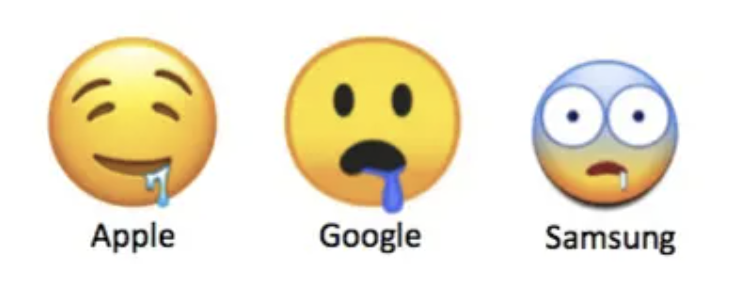
First, for anyone having had experience with different phone brands and platforms, it’s pretty astounding how different the ‘same’ emoji can look. Take for instance this range of ‘drooling’ or ‘person frowning’ emoji, depicted below. The emotion they exude is quite inconsistent; whereas the first drooling face seems to say ‘mmm, delicious’, the second has more of a ‘vegetative state’-feel to it, and the third has seen stuff, if you know what I mean. The frowning girls are also pretty dissimilar, with the first one looking like you broke up with her, the second seeming more disappointed/disinterested in you, and the third one looking plain angry.

Also, anyone using platforms where shorthand can be used to call upon emoji (such as Slack, or the discontinued MSN Messenger), may have had the experience of conveying the emotion depicted by an emoji, simply by using the shorthand. For instance, I still regularly use โ€œ:aap4:โ€ (which would upon completion have transformed into a cute animated monkey, in MSN Messenger) on platforms which do not support or recognise that animation/shorthand. Of course, this implies that you and your communication partners share a common (visual!) โ€˜dictionaryโ€™ of emoji. This just goes to show that peopleโ€™s internal representations of emoji play a large role in their effectiveness as a means of communication.

There has been some interesting research on emoji done so far that seems to confirm the sense that emoji can be pretty noisy: a 2020 study found “limited shared agreement for the majority of emojiโ€“emotion pairings, and significant variation as to which emotion category a โ€œcomparableโ€ emoji belonged depending upon the viewed platform”. In other words; you’re likely to perceive the emoji’s emotional meaning differently depending on the variant you come across.

So, I guess my personal take-away from all of this is… it doesn’t hurt to double-check (or give people the benefit of the doubt) if you’re unsure about the message someone is trying to get across.

BONUS TRIVIA: Do you know what the difference is between emoticons and emoji? Well, apparently emoticons are ‘faces’ constructed with typographic symbols, like “;)”. Emoji, on the other hand, are the actual picture-faces (or vegetables, or whatever), like the ones in the pictures above. The more you know.

Emotions II

In my previous blog, I gave a short intro to some of the thoughts psychologists and neuroscientists had in the 19th century around the emergence of emotions. However, with a new century came new ideas, and the 1920s saw Walter Cannon and Philip Bard directly challenge the James-Lange theory. Instead of emotions following from physical reactions, they proposed that our physiological responses, such as trembling or breathing rapidly, are in fact independent from emotions and simply occur simultaneously.

To translate this to our earlier example, imagine that you are walking down a new dark and empty street when again you suddenly hear someone trailing behind you. According to the Cannon-Bard theory of emotion, you start feeling afraid and at the same time your heart starts to race, largely independently from each other. They asserted that emotions can be experienced without the presence of physiological responses, and that a theory of emotion should reflect this.

Both theories have been heavily criticised, but as always there seem to be bits of truth hidden in both. In an attempt to integrate the two approaches, more recent theories of emotion (such as the two-factor theory proposed by Stanley Schachter and Jerome Singer in the 1960s) attempt to highlight the role physiology plays in the formation and experience of emotions while still accounting for the fact that physiological reactions such as trembling are not specific to one particular emotion but instead are similar for multiple different emotions.

There are many more theories around emotions, such as James Gross’ emotion regulation theory, which I may write a blog about some time in the future.. One thing is for sure: whether physiological reactions generate emotions or just accompany them – emotions usually serve a certain function. Understanding what your body is trying to tell you will help you understand yourself and your environment, making life just a little bit easier. (:

An earlier version of this blog post can be found on the GEMH Lab website. Here, I have updated that post slightly.